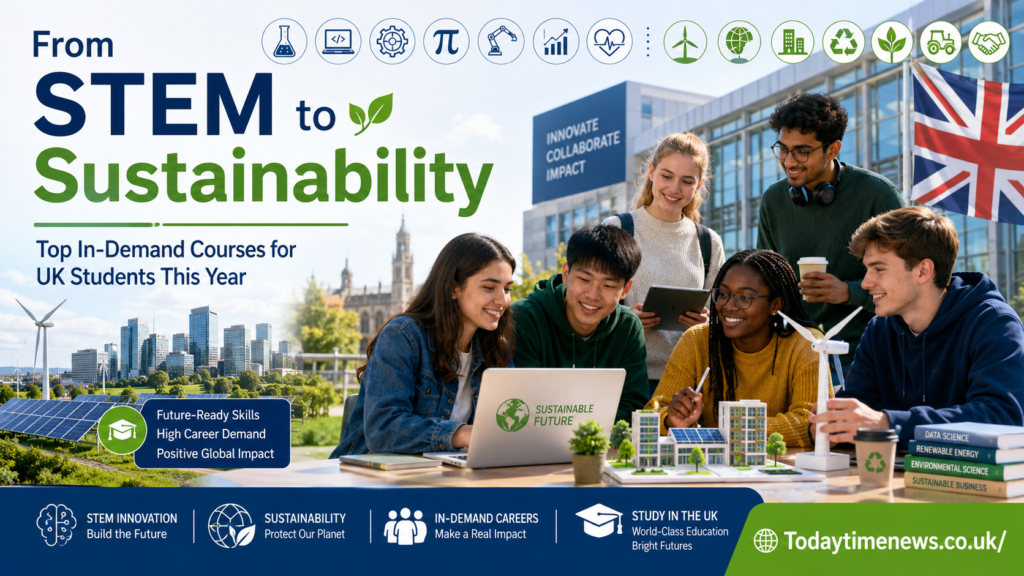

The landscape of higher education in the United Kingdom is shifting rapidly. As we move through 2026, the traditional boundaries between subjects are fading. Modern students are no longer just choosing a degree based on a name; they are choosing paths that offer long-term job security and the chance to solve global challenges. From the surge in Green Technology to the expansion of Artificial Intelligence, the academic choices made today will define the British workforce for the next decade.
The Evolution of the UK Job Market
The UK economy is currently experiencing a “twin transition”—the simultaneous push toward a digital-first economy and a Net-Zero future. This shift has created a massive demand for specific skill sets. Employers are no longer just looking for general graduates. They want individuals who can bridge the gap between technical theory and practical application. Whether you are a domestic student or an international learner coming to London, Manchester, or Edinburgh, understanding these trends is the first step toward a successful career.
For many, the jump from A-levels or Foundation years to university-level research is quite steep. The complexity of modern modules means that many learners often look for help with assignments online to ensure their grades match their professional ambitions. This support allows students to focus on mastering the core concepts while staying on top of their heavy academic workload.
1. Sustainability and Environmental Science
Sustainability is no longer a niche elective; it is the foundation of modern business. With the UK’s commitment to reaching Net-Zero by 2050, every industry—from construction to fashion—needs experts who understand carbon accounting and environmental law.
Degrees in Renewable Energy Engineering and Sustainable Development are seeing record numbers of applicants. These courses teach students how to design circular economies and manage natural resources. Graduates from these programmes are finding roles as sustainability consultants, environmental analysts, and green project managers. The focus here is on “Real-World Experience,” where students spend time in the field measuring biodiversity or auditing energy efficiency in local council buildings.
2. The Next Frontier of STEM: Artificial Intelligence and Robotics
While STEM has been a buzzword for years, the focus has narrowed toward AI and machine learning. UK universities are now world leaders in teaching how automation can be applied to healthcare, finance, and logistics.
However, the technical side of these degrees remains incredibly challenging. Students are often required to dive deep into the hardware-software interface. For example, understanding how a processor handles complex AI algorithms is a core part of the curriculum. If you find yourself struggling with the logic of logic gates or processor design, getting computer architecture assignment help can be a game-changer. This ensures you grasp the underlying hardware principles that make high-level AI programming possible.
3. Healthcare and Biomedical Sciences
The UK continues to face a shortage of healthcare professionals, but the roles are becoming more technical. We are seeing a high demand for courses in Health Informatics and Genomic Medicine. These subjects combine traditional medicine with data science, allowing for personalised patient care.
Students in these fields are expected to show high levels of “Expertise and Authoritativeness” from their very first year. The pressure to produce accurate, evidence-based research papers is immense. This is why the UK academic system is so respected—it forces students to think critically and back up every claim with peer-reviewed data.
4. Data Science and Business Analytics
Data is the new oil, and the UK’s financial sector in the City of London is hungry for people who can interpret it. Courses in Business Analytics and FinTech are perfect for those who have a passion for mathematics and a desire to work in a corporate environment.
These programmes teach you how to use Python, R, and SQL to predict market trends. The goal is to turn raw numbers into a narrative that a CEO can understand. It is a perfect blend of technical skill and communication. Many students choose these courses because the starting salaries in the UK for data analysts remain among the highest for new graduates.
5. Creative Arts in the Digital Age
The UK’s creative industries contribute billions to the economy. However, the “Top In-Demand” courses in this sector have changed. Traditional Fine Art is now being joined by Game Design, UX/UI Design, and Digital Content Strategy.
These courses require a mix of creative vision and technical proficiency. A student might spend the morning drawing character concepts and the afternoon coding in C# or using game engines. It is a diverse and exciting field that reflects the UK’s position as a global hub for entertainment and media.
Why Quality Content Matters for Your Degrees
In every one of these in-demand subjects, the “Trustworthiness” of your research is what will get you a First-Class degree. UK professors are notoriously strict about plagiarism and the depth of one’s arguments. To succeed, you must demonstrate that you have engaged with the latest industry reports and academic journals.
The transition to these high-level courses can be stressful. Balancing a part-time job with a rigorous STEM or Sustainability degree is a common struggle for many in the UK. This is where professional academic resources become invaluable. Utilizing external support to refine your writing or understand a complex technical topic is a proactive way to manage your education.
Conclusion
Choosing a course is about finding the intersection between what you enjoy and where the world is going. The UK remains one of the best places in the world to study because its universities adapt so quickly to global changes. Whether you are interested in saving the planet through Green Tech or building the next generation of computers, the opportunities are vast.
Focus on building a portfolio of skills, stay curious, and do not be afraid to use the tools and support systems available to you. Your academic journey is the foundation of your future career, and in 2026, that foundation needs to be stronger than ever.